



Songs About Singing & Music
- A Song and a Smile
- Å vil du hava meg til å kveda
- Aven Roma
- Bell is Ringing
- Bonse aba
- Call to Singing
- Calon Lân
- Canten señores cantores
- Come Let’s Sing a Merry Round
- Come, Come, Come
- El grillo
- Follow Me
- Give Said the Little Stream
- Grandma Grunts
- Hava Nagila
- Hava Nashira
- Himmel und Erde müssen vergeh’n
- How Can I Keep from Singing?
- I Got Rhythm
- I Like to Sing When the Sun is Shining
- I’m Gonna Sing When the Spirit Says Sing
- Joy Bells
- Let Us Endeavor
- Let Us Sing Together
- Merrily Merrily Sing
- Music Alone Shall Live
- Music of Thy Voice
- Musica est Dei donum optimi
- Now We are Singing
- O Music
- Oh I’m Goin’ to Sing
- Play A Simple Melody
- Se canta
- Sea Shell
- Sing-a-Ling-a-Ling
- Sing a Song at Twilight
- Sing a Song of Sixpence
- Sing Gaily Sing
- Sing Together
- Sing You Merry Bird
- Sing Your Way Home
- Singen is inser Freid
- Singing
- Singing in the Land
- Song of All Songs
- Soft Music is Stealing
- Sounds of the Singing School
- Sunny Spain
- Sweetly Sings the Donkey
- Tinker and Cobbler
- Un poquito cantas
- Upward Trail
- Viva la Musica
- Wake a Song of Joy and Gladness
- Walk Together Children
- We’ll All Go A-Singing
- Welcome Every Guest
- With Voices Merry
- Ya Shadi Al-Alhan
Songs for Solo Singing
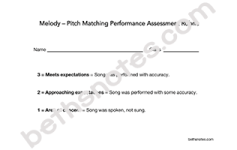
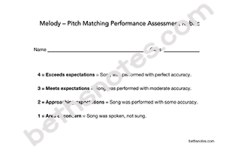
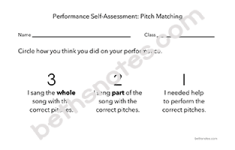
Pitch Matching Performance Assessment Rubrics
Why We Sing
Sing! Sing! Sing! It is so important to our health, our self-esteem, our sense of community, etc. We need to be reminded and need to remind others. Our voices are instruments we carry around with us at all times. We can make music in any place, at any time. It’s a gift we can give others, to sing and teach them how to sing.
Do you realize that most of us live in cultures where instead of making music, we consume music? We buy and sell and listen to music, but we don’t make music. There was a time before recorded music when almost every family had a piano in their home, and someone in the family knew how to play. Now? Everyone has a device that plays music for us.
I had a friend who took a trip to South Africa. In the area where she visited, she said the children sang all day long – as they were getting on the bus and going to school and in all other regular parts of life. Oh, to live in a culture like that!
So, our music classes are some of the only places where children will be encouraged to make music.
First, let me quote from one of my favorite books* to remind you how singing changes lives. And tomorrow… let me give you some ways you can explain it to others.
- Music charges the brain, energizing it like a million-volt battery.
- By charging the brain, singing serves a basic function – it satisfies the hunger for mental stimulation.
- The ability to sing involves the ability to hear sounds inside the head. Inner hearing is an essential mental process – everything from reading to problem solving requires inner hearing.
- Music making helps the child distinguish different sounds.
- Making music is a terrific aid in improving memory.
- When we sing and make music, we are using both sides of the brain – both the logical and the creative side. The more we sing, the more we strengthen the communication between the two sides of the brain.
- Sound production is good for the body. When we sing in a group, we can feel the vibrations on our skin and in our internal organs. We are receiving a marvelous massage of sound, both inside and out.
- The ability to sustain a rhythm, to feel the pulse both physically and mentally, is extremely important for learning.
- Child can learn social skills through singing.
- Music making can building communities, whether these communities are schools or entire cultures.
- Singing brings people together and helps form group identities.
- It is not good enough to stand by and listen to others. We must each make music ourselves.
So what can we do?
- Sing often! Create an atmosphere of singing.
- Encourage those who feel self-conscious about their voices.
- Sing in the range of your students. Younger students need to sing the notes between Middle C and the octave C above that. They need to practice sirens and saying “yoo hoo” and other activities to place their voices in the right range. They need to practice the difference between singing voice and talking voice. (see Voices post)
- They need to sing inspiring songs that tell a story (ballads here, Spirituals here), songs that reflect their cultural identity (see songs from different countries & cultures) here, silly songs, songs with games and movement, etc.
* Sing and Shine On: An Innovative Guide to Leading Multicultural Song by Nick Page
Singing & the Standards
Now, how do we convince others (administrators, parents, students, etc) of the importance of singing? We do not need to conform to the pencil/paper culture of other subjects. (Of course, sometimes we need to use pencil and paper, but certainly it’s not the majority of the time.) We need to actively participate in music making. And our principle instrument is internal: our voice.
The NAFME website names the core music standards as:
- Creating
- Performing
- Responding
In particular:
- Students need to have experience in creating, to be successful musicians and to be successful 21st century citizens.
- Students need to perform – as singers, as instrumentalists, and in their lives and careers.
- Students need to respond to music, as well as to their culture, their community, and their colleagues.
Our reason for being is not to simply give the other teachers a planning period. Nor is it to practice math, reading and writing (of words). It is in developing our voice, our inner ear, our sense of rhythm and phrasing, our ability to “enter” different times and places by singing songs from history and other cultures – that allows us to become better at all of the other subjects!
In Early Childhood classes, babies and young children improve their language skills, expression, balance. Young readers learn their alphabet and rhyming words – and yes, they reinforce their reading ability if you put the lyrics on the screen as they sing – or even if you only put up the rhyming words (see this song). Counting songs help reinforce their numbers. But, by adding the tune and motions, they are able to learn more quickly and store the memories more permanently in their brains. And all of the different learning styles are being taught!
Students can experience putting different sections of music together (verse/refrain; AB). And they don’t have to just learn about form, but they can make their own contrasting sections (see this song). My recorder book has several songs like this. Also, I tell the students singing is one of the only ways they can “go back in time” – by actually singing songs that were sung by people long ago. (We can’t wear their clothes or eat their food, but we can sing their songs!) We can enter into other cultures by singing their songs, which of course, aids in learning other languages. Of course, sign language is also a language!
Teach them to sing with expression: it improves their empathy.
Teach them to listen to each other as they sing. We are all on the same team with the same goal! There are NO winners and losers in music! The better you do, the better I do! We become more socially conscious and more kind and respectful citizens.
Shout it from the rooftops! Put up signs of quotes that promote music education (see tomorrow’s post). Add music quotes to your school’s website or newsletters….
You are one of the only advocates in your building for your super-important subject. So, sing!!!
Active Music
It’s always a good reminder to include more music-making activities than music-explaining lecturing in our classrooms.
More:
- Singing
- Moving
- Playing instruments
- Improvising
- Composing
Make a goal for yourself to include 3 of the above activities in each lesson.
Less:
- Lecturing
- Memorizing facts
- Writing (on worksheets and tests)
Quality Singing
In short, we must be teaching students to sing in their head voices. If you are unsure of the difference between head voice and chest voice, see this video.
Why head voice, not chest voice, should be taught to children:
- Head voice has a clearer, zinging, resonant tone, and has the potential of being more in tune.
- Head voice nurtures the young voice, since the beauty of the young voice is high.
- Chest voice tones tend to be breathy and do not have resonance. True resonant singing creates overtones.
- Chest voice limits range and styles.
- Chest voice can lead to vocal nodules (see physiology below).
Why head voice is often not taught:
- Teacher is uncomfortable with their own head voice and may feel vulnerable singing high. It’s easier to take the speaking voice into singing.
- Much music (yes, even children’s music!) is pitched too low.
- Pop culture doesn’t model the head voice.
Physiology:
When a person makes a sound, vocal folds (cords) vibrate against each other 100-400 times per second. When a person uses head voice, the vocal folds hit each other with less force and vibrate on the edges. With the chest voice, vocal folds hit each other head-on with more force and thicken, and can be damaging unless the person really supports correctly.
As a result, vocal nodules can form. Nodules are nodes which usually occur in women (men have thicker vocal folds). It can be treated with voice therapy (teaching proper breath support) and sometimes requires surgery.
Some ways to keep the kids singing in their head voices:
- Model head voice! Be aware of your singing – and speaking! – voice. Are you over-singing or over-speaking? Consider getting a headset microphone so you can sing and talk quietly. See this post about protecting your voice.
- Tell your students to limit yelling (i.e. cheerleading) and not to over-sing in a pop voice for long periods of time.
- I make a point to say, “I don’t like to yell; it’s bad for my voice.” (And when I have to call my kids for dinner, I use my “yodeling” voice – “Yoo hoo!” OK, when they were teenagers, they (and some of their friends) laughed at me…)
- Do not teach songs that go lower than Middle C. The natural range of children’s singing voices is between middle C and the C one octave higher.
- Stay away from pop songs, which encourage students to emulate their favorite pop singers (who are most likely singing in unhealthy ways). Tell them if they are going to sing with the radio to sing softly and don’t “belt” it out.
Oh no, if you can’t choose pop songs, then what will they sing? And the answer is: FOLK SONGS! They are catchy, fun to sing, and they don’t have a copyright! What’s not to love?! And what’s your favorite source for folk songs? bethsnotes.com! (OK, forgive me, I’m getting carried away…)
- “But my students are mumbling instead of singing.” OK, I know. Even some of the youngest students (especially boys) mumble in a low monotone. I will write more on this later, but suffice it to say: encourage students to “find their singing voices” instead of using their “talking voices.” Foster a safe and fun atmosphere in your class – where singing is fun, and no one will make fun of anyone else.
Famous people with nodules:
- I have gotten my information from the internet. Please forgive any errors.
- Also, a person who gets nodules is not necessarily singing “incorrectly,” but being a professional singer or talker can take its toll!
- Julie Andrews
- Kenny Rogers
- Rachael Ray
- Miley Cyrus
- Luciano Pavarotti
- Whitney Houston
- Matthew West
- John Mayer
- Margaret Cho (comedian)
- Justin Timberlake
- Mariah Carey
- Annie Lennox
- Rod Stewart
- Joni Mitchell
- Madonna
- Bette Midler
- Sarah Brightman
- Robert Plant
- Freddy Mercury
- Idina Menzel
- Amy Grant
- Linda Rondstadt
- Patty Loveless
- LeeAnn Rimes
- Kelly Clarkson
- Joss Stone
- Charlotte Church
- Steven Tyler
- Stevie Nicks
- Bonnie Tyler
- Jordin Sparks
- Cyndi Lauper
Pick This Repertoire
Great music brings out the artistry in you and the children. Children deserve the best! I have found that music teachers often pick music that is trite and not well-written. This is why I usually choose folk songs. I wrote about folk songs in another post.
When looking for great repertoire for my chorus, it takes some serious thought. Both the students and I will be spending a lot of time with the pieces of music, analyzing, rehearsing, and memorizing. I have a responsibility to feed healthy music, not fast food to my students. That doesn’t mean they have to ingest brussel sprouts and hate it because it’s good for them. OK, enough with the food analogy. Let’s look at some practical advice.
What to look for in a piece of music. Questions to ask yourself:
- Has it withstood the test of time? Folk songs! Classics! Be careful with contemporary composers: if it was written yesterday, will it be around tomorrow? (Benjamin Britten & Aaron Copland are good examples of modern composers standing the test of time. Find modern composers with classic texts or poems.)
- What does it teach (students & audience)? Side note: don’t forget to educate parents at the concert with a written program or verbal introduction of the songs.
- Does it reflect another culture? Language considerations: Make sure students & audience know what the English translation is.
- Fresh test – Will you and/or students be tired of the piece in 3 months?
- Arrangement
- For elementary or younger middle school students, choose 2-pt, unison, rounds, partner songs
- With a folk song – Look at different arrangements; you may like one version of the text, melody or accompaniment better than another. Also, remember folk songs can be changed or arranged by you! If you aren’t using someone’s folk song arrangement, there is no copyright on the song!
- Is the piano accompaniment written well?
- Range / tessitura – common error – might be appropriate for adult singer, but inappropriate for young singers cultivating healthy singing habits. Try to pick songs where the majority of the notes are above middle C to develop their head voices. Students’ head voices have more resonance and vocal health than their chest voices.
- Lasting quality – By this I mean, is the song thought-provoking or meaningful – or maybe just fun. Fun is fine; just make sure you choose a balanced diet.
*Problem of Pop. I think of pop music like fast food. It might give you a rush, but it doesn’t stick to the ribs and provide lasting health. I have heard music teachers tell me, “My students won’t sing anything but pop!” I don’t believe it. That’s like saying your children will only eat McDonald’s. It’s how you introduce the quality repertoire – with passion for the message, the musicality, the story – whatever the “hook” is. It’s not like I don’t like pop. I just don’t like pop for my children’s choruses. For one, pop tends to be pitched too low, and students are tempted to sing it in the unhealthy belting tone of some of the pop singers they listen to. It’s not a good choral sound, and it doesn’t teach your students healthy singing habits. Pop music can be overly repetitious. It can also be very syncopated, which can be difficult for a group to sing well.
When putting together a concert, consider the following:
- Choose a variety: of periods, styles, tempi, meters, modes, etc.
- Think long and short range. Over a year, over several years, what have students been exposed to?
- Consider commissioning a local composer to write a piece for you.
- Score preparation – Make sure you know the piece as well as composer.
- Piece introduction – Be creative with how you teach the song to the group. As I mentioned, each song has something that makes it special. Start with that to catch the attention of the kids.
For instance:
- With Waltzing Matilda I started by telling my (American) students the story in a completely serious voice, using the Australian words like “jumbuck” and “tuckerbag.” At the end of the story, I asked them, “Can you believe that happened?” They laughed, because had no idea what had happened, but they were thoroughly amused and curious.
- With Little Birch Tree, I think the beauty lies in the “loo li loo” swelling and receding, as if the wind were blowing through the leaves. I turned off the lights and turned on the fan and sang the song. I taught them the “loo li loo” part first and sang it again, inviting them to sing that part – with crescendo and decrescendos – every time I did.
- With Sakura, the “hook” for me is the haunting melody. A good way to start that one might be playing the melody on an instrument or listening to an instrumental recording of it with traditional Japanese instruments. The students could begin learning the melody on “loo,” which would help them sense the long phrases. The students could also use scarves or ribbons – or even elegantly walk or “float” around the room while singing in order to emulate the long phrases.
- Give Us Hope by Jim Papoulis has inspirational lyrics that can spark some great conversations about the students’ hopes and dreams.
- When we sang Getting to Know You – from The King and I, I would make my rounds to all of the students and greet them and hug them while we sang.
- Erie Canal and Drill Ye Tarriers are up-beat folk songs that tell stories of work in the United States a century ago. Students can add drilling or rowing motions to the strong beats as they learn the songs.
- I even taught the kids a couple of Mozart songs in German, and during rehearsals we pretended we were wearing the stuffy clothes of the period with wigs on our heads while we sang.
Don't Pick This Repertoire
Did I grab your attention? Well, I’m not sure how to write this post without offending anyone. So, I guess I will just run that risk. My other article about how to pick great repertoire is a good place to start. But, sometimes it’s easier to learn by looking at a list of “what not to do.” And, I’ve got to tell you: choral readings don’t usually help you find good music. Most of those free pieces of music I get from those readings go in the recycle bin. So, here goes.
Steer clear of:
- Songs that have the students singing below middle C. Students are singing in their chest voices this low. See this post.
- Songs with cheesy lyrics. Penguins are Lousy Bowlers to the tune of a Mozart aria. Really? Maybe for a Kindergarten general music lesson, but, please, not for a choral concert!
- A Swahili song written by Bob and Jane Smith. How about a real Swahili song from Africa? Here’s a bad example I just found online: Con la Música by a very white guy (I’ve met him). There’s so much great Spanish folk music. Why do the unauthentic?
- The Medley of Justin Bieber hits
- I even consider the Hip Hop Reindeer to be a poor substitute for a rousing rendition of We Need a Little Christmas or Mister Santa.
- The Nutcracker in Three Minutes – We all know the Nutcracker is meant to be a ballet, not a three-minute choral piece. I shudder to think what those lyrics look like.
- We Believe in Music – Instead of this contemporary title with trite lyrics and simplistic piano accompaniment, how about something that has stood the test of time? Like To Music, a 16th century German chorale arranged by Betty Bertaux, or Music Alone Shall Live, a German folk song.
OK, I’ll end my diatribe. Please, do your part to save the next generation from poor-quality music!
Save Your Voice
I have heard it said that the three types of teachers who most often have vocal issues are PE teachers, foreign language teachers and music teachers. Many of you know how it feels when you start back to school and you experience vocal fatigue. You will very likely continue to do damage to your voice over the years of your teaching if you’re not careful.
Do:
- speak at your own pitch
- support speaking voice
- avoid dairy products prior to performance
- humidify bedroom during winter months
- avoid places with bad air
- drink lots of water: “Pee Pale, Sing Clear” – yellow can indicate dehydration
- rest, no stress, be happy, laugh a lot
- 20-minute vocal rest periodically
Don't:
- smoke
- drink coffee or alcohol before a performance
- drink many caffeinated drinks
- scream at sporting events or talk at noisy places
- phonate a sneeze or yawn
- cough or clear your throat repeatedly
- whisper loudly or for a long time
- try to talk over a cold or laryngitis
- sing outside, or if it hurts to swallow, or “over sing”
Other things I have done to help
- Stop singing along with the students all of the time.
- Sing directions instead of talking.
- Vocal rest during my lunch hour. Even 20 minutes of no speaking can go a long way.
- Support my breath not only when I sing, but also when I talk. Even a quick vocal warm-up on the drive to school can help.
- Not over-speaking while teaching. During a time in my life when my voice always seemed strained, I invested in a Chattervox. I used it for about 3-4 years until I got so used to talking at a normal volume that when I stopped using it, I was better at not over-speaking while teaching. I am absolutely convinced that had I not started using my Chattervox, I would have suffered from nodules. (Read more here about nodules.)
Why I Love Folk Songs
Most of the time, I would rather teach folk songs in my classes and programs than composed music for many reasons.
Folk songs…
- have stood the test of time.
- reflect the culture, values and stories from the countries they’re from.
- are often really fun and easy to sing!
- are not copyright protected.
- allow us to enter the story! I tell the students that we can’t wear the same clothes or eat the same food that people of our history did, but we can sing the same songs and dance the same dances.
Be aware that some songs are no longer appropriate for us to teach because of their racist roots or other topics that have since fallen out of favor.
Copyright
Did you know the copyright for “Happy Birthday to You” was finally removed on September 22, 2015 by a federal judge? (source).
Let’s see how much you know about U.S. copyright laws for music in schools.
(Disclaimer: I am not an attorney, so I am only relating the information as I have researched it to the best of my ability. These copyright laws pertain to the United States.)
Check Your Knowledge
True or False:
- In a school classroom we can sing whatever song we want without worrying about the copyright.
- I can make copies of copyrighted songs for educational purposes.
- If my chorus or band performs copyrighted pieces at the local mall, I need to have a performance license.
- If my students perform copyrighted pieces in our gym, I need to have a performance license.
- I can make video or audio recordings of my concerts (where copyrighted pieces are performed) and sell them without a license.
- I can make a copy of a CD that the music department purchased for another teacher in my school.
- I must ask permission to change the lyrics or script for a copyrighted song or play.
- I can post a recording of my students singing or playing a copyrighted song on YouTube.
- Breaking copyright laws is no big deal.
Do the following songs have a copyright? yes or no
- Kookaburra
- Yankee Doodle
- Happy Birthday to You
- Fifty Nifty United States
- Your state song / your national anthem
- Santa Claus is Coming to Town
- We Wish You a Merry Christmas
- Feliz Navidad
Answers
- In a school classroom we can sing whatever song we want without worrying about the copyright.
For the most part, yes, you can sing: not perform, not copy music, not make a video or audio recording. You can sing or play a recording of a copyrighted song in your classroom for educational reasons because it is covered under the “fair use” clause. (It’s called a “face-to-face teaching exemption”.) Be advised, though. You cannot even sing a copyrighted song in public if it is not covered in the “fair use” clause. (This is why the “Happy Birthday To You” song was not allowed to be sung in public – even in restaurants – until today, when the copyright was overturned in court. Read about it here.) - I can make copies of copyrighted songs for educational purposes.
No. Not octavos, not even lyric sheets. If you have purchased the choral copies and want to make lyric sheets, then you can possibly obtain permission from the publisher. But you need permission in writing. (Sometimes they will give you permission for free.) There are a few exceptions (read here), which include making copies of excerpts which do not exceed 10% of the whole piece or making emergency copies. - If my chorus or band performs copyrighted pieces at the local mall, I need to have a performance license.
Yes! Ask your school district if they have purchased a blanket performance license from ASCAP and/or BMI. (Read more here.) And… you need to have purchased the correct number of copies of music for the musicians. [Find out who owns the license to the song by typing in the name of the song on this website: musicservices.org. The performance licenses are issued by ASCAP (search here), BMI or SESAC. For instance, on this page, you can see that the music education performance cost is about $230/year. But you can fill out a form and ask them to call you.] - If my students perform copyrighted pieces in our gym, I need to have a performance license.
Yes! Same answer as above. The only exemption is the “face-to-face teaching exemption” of the “fair use” clause mentioned in #1. - I can make video or audio recordings of my concerts (where copyrighted pieces are performed) and sell them without a license.
No. You need a license if you make more than one copy. Parents can make one copy for themselves and teachers can make one personal copy, but even if you don’t charge for audio or video copies, you still need a license. - I can make a copy of a CD that the music department purchased for another teacher in my school.
No. The other teacher needs to purchase his/own copy of the CD. - I must ask permission to change the lyrics or script for a copyrighted song or play.
Yes. You may not change or add lyrics without permission. You may simplify, rearrange or edit copyrighted pieces for educational purposes, as long as it doesn’t change the “fundamental character” of the piece. - I can post a recording of my students singing or playing a copyrighted song on YouTube.
No. Unless you get permission. (Are you sensing a theme here?) - Breaking copyright laws is no big deal.
False. Copyright violations are subject to fines (between $750 and $150,000 – even $250,000 up to 5 years in jail for serious offenses). I doubt you want to pay that. And I doubt your school district wants to get involved in litigation.
Yes = copyrighted; No = public domain
Updated 2025: Songs composed in or before 1929 is now in the public domain. (source)
- Kookaburra – yes (under Australian copyright law; the composer died in 1988)
- Yankee Doodle – no (and neither is Yankee Doodle Boy)
- Happy Birthday to You – As of today, not anymore! Read about it here.
- Fifty Nifty United States – yes (published in 1961)
- Your state song / your national anthem – Every state (in the U.S.) is different! Look up your state here. Most national anthems that I have run across are in the public domain. I have many of them posted here.
- Santa Claus is Coming to Town – yes* (© 1934, renewed in 1962)
- We Wish You a Merry Christmas – no
- Feliz Navidad – yes* (© 1970)
*Read this list of popular Christmas songs. You may be surprised how many are copyrighted. I have lots of Christmas songs in the public domain posted here.
Here’s the GOOD NEWS: You can use public domain songs! For free! As much as you want!
Resources
- My website! I have over 2,000 songs in the public domain. And I’m always adding more! Here is an alphabetical list. Also: I hereby grant you permission to save and reproduce the folk song images on my website. (You can’t do that with other collections of folk music. Their versions or arrangements are copyrighted.) I just ask that you give me credit whenever you reprint my versions of the folk songs. Just mentioning “bethsnotes.com” is sufficient. (And yes, I know that there are some websites out there that have completely copied and pasted entire posts of my website and claimed it as their own. Annoying.) Also, if you purchase membership-only material, I give you the rights to use that material (including making copies, performing and recording) with your classes today, tomorrow and forever. (Please just give me credit in the program notes or on copies you make.) I ask that you kindly do not make copies for other teachers to use for themselves or in their classrooms. See Terms of Use.
- Check out websites such as ibiblio.org/mutopia and pdinfo.com for more public domain music.
Books
(Click on images to purchase.)


- Pitch-Matching Rubrics
- Behavior Notice for Specials
- MUSIC letters in English
- Music Awards in English
- Music Awards in Spanish