
Preparing a Concert
When you start a new music teaching job, you might get very little direction about what to do about your concerts, except what the dates are. Here are some things to consider:
1. First things first.
- Check if date has been planned.
- Check if an evening concert will include a stipend.
2. Choose theme/songs.
- What has been done in the past?
- Expectations of teachers/parents?
- Philosophy of building (Do they want a simple program only involving the music teacher; do they expect a grand production with other teachers/parents helping?)
- What songs are available? appropriate? educational? (Is there a budget to order music?)
- Check if classroom teachers do programs/ themes.
- Add extras: movement (motions, hand jives, sign language, dances), instruments, narration, costumes
- Assign parts and send note home to parents. Find a time to rehearse with those students and/or ask parents/teachers to help.
- Balanced program: folk songs, songs the audience will recognize, and newer composed songs.
3. Reserve risers
- How many and from where?
- Need them to rehearse a few days prior?
- 3 or 4-step risers? With shell? With guard rail?
- Fill out a work order?
4. Reserve space
- What set up do you need?
- Equipment? (instruments, mike, podium, music stand, stage)
- Fill out a work order?
- Scenery – work with parents or art teacher
5. Find accompanist. Pay? (Ask school or PTA.)
6. Communicate!
- Let principal, teachers and secretaries know well in advance what you are planning, especially if there are any schedule changes.
- Give parents plenty of notice through newsletters and notes home. I usually send two notes home: one several weeks in advance that announces the date and time, and one about a week in advance that gives details. Even give them a gentle reminder of what the audience etiquette is.
- Put it on the website!
7. Dress rehearsal
- Special schedule during the day? Let teachers know in advance!
- Before/ after school rehearsal: permission slip to go home.
- Mandatory chorus rehearsals before a concert; remind parents.
8. Programs
- Cover: buy, art teacher or student design, computer-designed.
- Inside: Who will type? Write names of any volunteers, accompanist, instrument players, chorus students. Also include composers/arrangers.
- Who will photocopy? fold?
9. Discuss with students
- Arrival time and place to meet
- Performance behavior
- What order to line up in
- How to get on/off risers
Concert etiquette
Concert Etiquette Rubric
4 = Student consistently stood still on stage, participating, not talking to others, watching conductor. Student’s motions never disturbed other students.
3 = Student mostly stood still on stage, participating not talking to others, watching conductor. Students’ motions hardly ever disturbed other students.
2 = Student was somewhat wiggly and/or talkative and/or did not consistently watch conductor. Student’s motions slightly distracted others in the concert.
1 = Student was very wiggly and/or talkative and/or did not watch conductor. Student’s motions distracted others in the concert.
This is what I explain to the students:
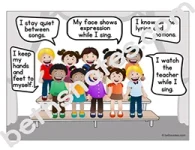
Before the concert (during class), you will be graded on Effort.
During the concert you will be graded on:
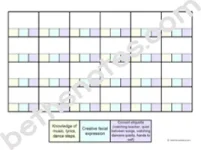
- How well you know the words, motions & dance
- Expression
- Etiquette, which includes:
- Watching me
- Keeping your hands and feet to yourself
- Staying quiet between songs
- Standing still
- Participating
Performance Rubrics for Concerts / Concert Seating Chart / Poster


Audience Etiquette / Expectations
“A painter paints his pictures on canvas.
But musicians paint their pictures on silence.
We provide the music, and you provide the silence.”
– Leopold Stokowski, reprimanding a talkative audience
OK, let’s face it: people (both adults and children) don’t know how to behave at a concert. In one concert, a father in the front row threw a flip flop at the singers. Another time, a mother in the front row was talking on her cell phone during the whole concert. Once, a father was so busy filming that he let his 3-year-old boy come up front and join us on stage – twice. Babies crying and parents talking loudly to each other are just regular occurrences.
We have a choice. We can get angry and complain that people aren’t cultured. Been there, done that. But, if you think about it, most people (at least people in my area) don’t frequent “artistic performances” where audience participation is not part of the atmosphere. Also, it can’t be assumed that people from other countries know our expectations. So, we need to educate our parents and students.
Audience Etiquette Expectations (Suggestions for a Pleasant Evening)
Familiarize the students with the list of audience expectations before the concert and ask them to talk to their family and friends about it. Include this list on any correspondence and on the website.
- Do not talk during the performance.
- Silence cell phones.
- Limit movement in and out of your seat during the performance.
- Do not shout, whistle, or cheer while students are singing.
- Keep small children with you at all times.
You or an administrator could start the concert in the following way:
“OK, let’s have some photo ops. I’ll step out of the way so you can take some great photos of your kids. [Then, after a few minutes] I’ve told the students that they can smile and wave at you before and after the concert, but not during the concert. [Try to make it light and funny.] The kids have been working so hard at learning all of the lyrics and motions – and this will only last about 30 minutes. So we ask that for 30 minutes you turn your cell phones off – and if there’s an important call, you take it into the hallway. Please keep an eye on your toddlers – and keep the aisles clear. We want to make sure all of you can see and hear your children, so stay seated – and this will be a great 30 minutes!”
Program Ideas


- A You’re Adorable
- Big Beautiful Planet (Raffi)
- Down By the Bay
- Goin’ to the Zoo (Tom Paxton)
- Rock to Get Ready for School

- They’re Just Bugs (John Riggio)
- Itsy Bitsy Spider – with additional lyrics found in this book
- Boll Weevil (see my adapted lyrics)
- Inchworm (Frank Loesser)
- La cucaracha
- Ants Go Marching


Songs
- Music Alone Shall Live
- Thula Klizeo (Joseph Shabalala) Dance instructions and story of the song available in this book: Sing and Shine On, by Nick Page
- Star Spangled Banner
- Fifty Nifty United States (Ray Charles)
Dances

Songs
- Waltzing Matilda
- The M.T.A. Song (Massachusetts Transit Authority)
- Away to America by Linda Williams
- Old Joe Clark
Dances


- This Land is Your Land
- America (My Country ‘Tis of Thee)
- The Star Spangled Banner
- When Johnny Comes Marching Home
- Grand Old Flag
- This is My Country
- This Land is Your Land (Small group on Verses 1 and 2 / all on Verse 3 and Refrain)
- America (My Country ‘Tis of Thee)



- Simple Gifts
- A Gift for Santa (Teresa Jennings)
- Old Santa Claus
- Chipmunk Song (R. Bagdasarian)
- Dayenu
- Song of the Dragon
- Christmas Day
- It’s Almost Day
- Perry Merry Dictum Dominee
- The Gift of Love – songs about love
- The Gift of Family – songs about family


Introduce each song by singing the first phrase of the Twelve Days of Christmas, but change the lyrics to…
- “On the first day of Christmas we hang the decorations” – Deck the Halls
- “On the second day of Christmas we trim the Christmas tree” – O Christmas Tree
- “On the third day of Christmas we build a snowman” – Frosty the Snowman (Nelson & Rollins)
- “On the fourth day of Christmas we watch for Santa Claus” – Here Comes Santa Claus (Autry & Aldeman)
- “On the fifth day of Christmas we play out in the snow” – Snow Day (Riggio)
- “On the sixth day of Christmas we write to Santa Claus” – The Best Gifts (Jennings)
- “On the seventh day of Christmas we take a walk outside” – Winter Wonderland (Bernard & Smith)
- “On the eighth day of Christmas we wait for Santa Claus” – He Delivers (Sherman)
- “On the ninth day of Christmas there’s Christmas in the air” – Silver Bells (Livingstone & Evans)
- “On the tenth day of Christmas there’s shopping, shopping, shopping!” – The Christmas Rush (Albrecht)
- “On the eleventh day of Christmas it’s looking more like Christmas” – It’s Beginning to Look Like Christmas (Willson)
- “On the twelfth day of Christmas we give a gift of love” – The Gift of Love (Silversher)
See also
- Music Program Performance Rubric (PDF)