




1
2
3
4
We use cookies to improve your experience on our site. By using our site, you consent to cookies.
Manage your cookie preferences below:
Essential cookies enable basic functions and are necessary for the proper function of the website.
These cookies are needed for adding comments on this website.
These cookies are used for managing login functionality on this website.
Statistics cookies collect information anonymously. This information helps us understand how visitors use our website.
Google Analytics is a powerful tool that tracks and analyzes website traffic for informed marketing decisions.
Service URL: policies.google.com (opens in a new window)
SourceBuster is used by WooCommerce for order attribution based on user source.
Marketing cookies are used to follow visitors to websites. The intention is to show ads that are relevant and engaging to the individual user.
Facebook Pixel is a web analytics service that tracks and reports website traffic.
Service URL: www.facebook.com (opens in a new window)
You can find more information in our Cookie Policy and Privacy Policy.
your blog is amazing. It has helped me so much.
Thank you
Oh, I’m so glad, Rebecca!
Beth,
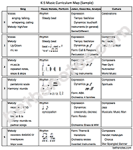
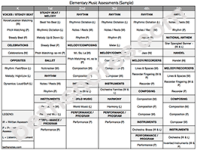
I love your blog. A couple of questions… Do you have any recommendations for extensions for seeing kindergarten twice a week for 30 minutes each time? Also, I noticed on your 5th grade chart that you have a “Boomwhacker Rock” song…but I haven’t been able to find a post about it. Do you use boomwhackers much, and if so, am I just missing the posts?
Thanks!
Becca Jane,
That’s wonderful that you see Kindergartners twice a week! I would expand into 1st grade territory: melody (so-mi), add more instrument parts, etc. I wonder how many people that affects. I would think you’re the exception, rather than the rule, but it’s a GOOD thing!
As for Boomwhackers, I don’t use them very much. I find the tone somewhat “flat” and bothersome – and with each Boomwhacker being a different, note, it can be difficult to teach them how to use them well. That being said, I use them to teach major scale, because it’s nice for them to visualize the lower tones being longer. I adapted “Boomwhackers Rock,” by Bradley L. Bonner. It’s copyrighted, so I can’t post it here. Does that help?
Yes, very much, thank you!
Thanks so much for sharing your wisdom and resources! I stumbled into a job as a music teacher at an English speaking school in Brazil. I minored in music in college, and have always worked in education in some capacity, but I have no formal training. I am in the process of trying to determine how to by my teaching degree, but in meanwhile your blog is helping me immensely. Thank you!
Beth,
Thanks so much for sharing your wealth of information on this site! I’m an Arts Integration Specialist and plan to recommend your site to teachers as we work on integrating more music in and through the curriculum and Common Core Standards. I wonder – do you ever curriculum map with the standards using your scope and sequence above? I’d love to collaborate with you at some point!
Susan Riley
Founder, EducationCloset.com
Susan, I am glad any of my resources are helping you with your goal of integrating music into the curricula of other subjects! No, I have not mapped my curriculum in the way you are probably thinking. I am open to collaborating with you! 🙂
Your blog is amazing and so helpful! I’m enjoying browsing your song categories – so much easier and more informative than all the fluff found in my classroom books!
Really Amazing Blog…. really Support. warm regards from Indonesia !!
As a first year teacher your blog as helped me so much! Thank you so much for being such a great inspiration!
I’m pretty sure that I use this blog daily. I love all the ideas and that the resources are easily available. Thank you, thank you, thank you!
Oh, I’m so glad to hear that! You are SO welcome! 🙂
Thank you SO much for your time and effort on your blog! I am a 2nd year teacher and very eager for this next year with all the creative and well-organized lessons you have here. 🙂
Nicole
Hi Beth! Love your lessons! Recently, my school’s Pre-schoolers were “placed” in Kindergarten General Music Classes. The student ratio of these classes is now 11 Pre-schoolers (3 and 4 year olds) to 7 Kindergarteners. No guidelines were given as to what/how to teach the 3 and 4 years olds regarding music.
I would welcome yours or any of your followers input on what a balanced curriculum might look like for these new, age-diverse music classes.
These classes occur once a week and are 35 minutes long.
Thanks!
E
E, I would suggest your curriculum for Preschool be the same as Kindergarten: include steady beat, high/low, loud/soft, voices, etc. Keep your lessons fast-paced, moving from one song/chant to another quickly. Then repeat those same songs over several lessons. Use fingerplays, circle dances, nursery rhymes and other active lessons. Enjoy! – Beth
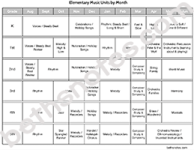
Good day! I love, love, LOVE this resource! Thank you so much for making it available. I use your resources often! I was looking over your curriculum map and saw that you don’t address high/low with kinder until the second semester. I assume you find this beneficial. I’ve been teaching it earlier, but do you find that they are more prepared by January?
Thanks!
Hi! Thanks for writing! I don’t think it matters, especially for Kindergarten. I taught it that way because at the time, the school district wanted me to teach the “Celebrations” unit 1st semester, and I didn’t have time to do high/low until 2nd semester. I prefer to start the year with steady beat and voices (singing vs. talking especially), because I feel those are concepts I continue to use throughout the year. Otherwise, I don’t think it matters when the other things (high/low, loud/soft, etc.) are taught. 🙂
Has your district been moving towards Core Arts Standards? We’re moving to create SMART standards, I can statements, formative/summative assessments, rubrics, etc. Have you had to update or redo any of your curriculum maps, etc. yet?
I haven’t taught in the public schools in a few years, so I’m sure they have made those changes. I would be very interested in the process your district is going through to redo the curriculum maps. What state are you in?
Your blog is amazing and I have been following it since you first started it, I think. I am for the first time teaching general music to 6th grade and was wondering what you would add to the curricular chart. Where would you add learning about triplets?
Thanks!
Hi! I’m so glad you find the website helpful! 🙂
I think triplets would work better for the upper grades, such as 5th or 6th.